When ISO 14001 was first published in 1996, it was a response to a growing global awareness that environmental responsibility could no longer be left to voluntary pledges or fragmented regulations. The late 20th century saw rising concerns about industrial pollution, resource depletion, and climate change. Businesses were under pressure to demonstrate accountability, and governments sought a unified framework to guide environmental management. ISO 14001 emerged as the world’s first internationally recognised Environmental Management System (EMS) standard, giving organisations a structured way to measure, manage, and improve their environmental impact.
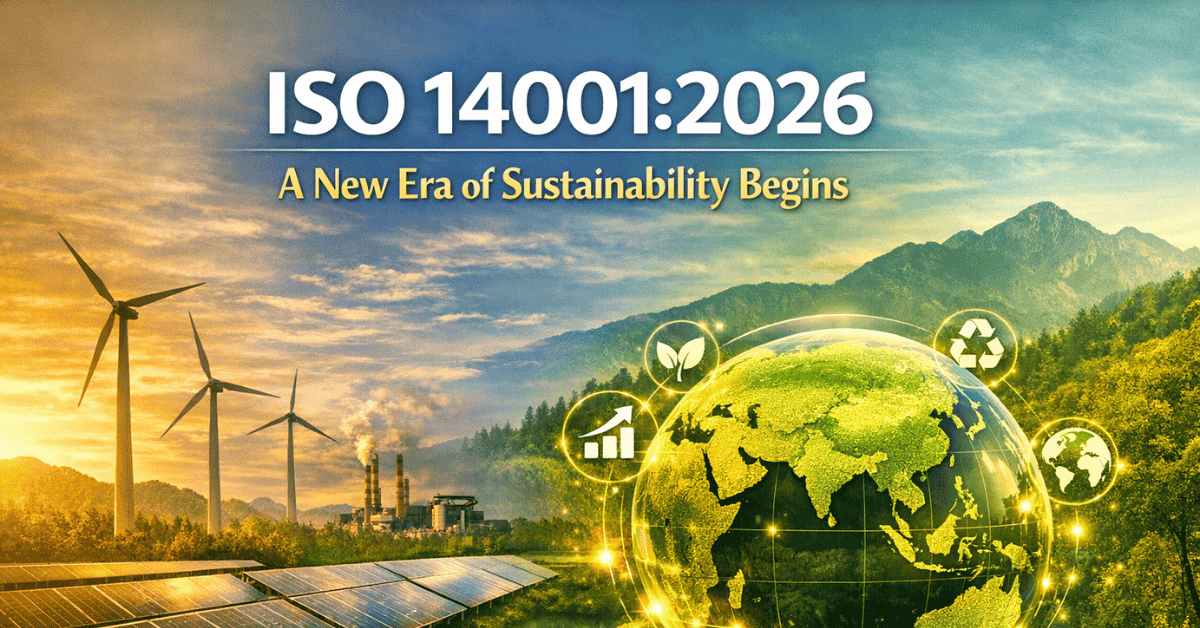
Over the years, ISO 14001 became the most widely adopted environmental standard, with hundreds of thousands of certifications worldwide. It was revised in 2004 and again in 2015 to reflect evolving sustainability priorities. The new edition, ISO 14001:2026, has been recently released on April 15, 2026, after a gap of 10 years. Why such a long interval? Updating a global standard is a monumental task. It requires years of research, consultation, and consensus-building among industry leaders, regulators, academics, and environmental experts across continents. The decade-long effort reflects the complexity of aligning diverse perspectives while ensuring the standard remains practical, credible, and globally relevant.
The triggers for this revision are clear. In the past decade, climate change has accelerated, stakeholder expectations have intensified, and digital technologies have transformed how organisations report and measure performance. The new edition responds to these realities by placing stronger emphasis on measurable results rather than policy statements. Organisations are now expected to demonstrate tangible reductions in emissions, resource use, and environmental risks. ISO 14001:2026 also integrates climate resilience, stakeholder engagement, and digital transparency into the EMS framework, ensuring that sustainability claims are backed by evidence.
The benefits of ISO 14001 remain powerful, but the new edition makes them sharper:
- Improved efficiency through resource optimisation and waste reduction
- Reduced environmental footprint with measurable, verifiable outcomes
- Enhanced credibility with regulators, investors, and communities demanding proof of sustainability
- Global recognition as part of a trusted ecosystem of standards
- Future-readiness by embedding climate resilience and digital accountability
Who should use ISO 14001:2026? The answer is simple: any organisation—manufacturing plants, service providers, SMEs, or multinationals—that seeks to embed sustainability into its strategy and operations. Whether driven by regulatory requirements, investor expectations, or corporate responsibility, ISO 14001 provides the framework to turn ambition into action.
ISO 14001 belongs to a broader family of environmental standards that reinforce its impact. ISO 14004 offers guidance for implementation, ISO 14064 supports greenhouse gas measurement and reporting, while complementary frameworks like ISO 9001 (Quality Management) and ISO 45001 (Occupational Health & Safety) enable integrated, responsible business practices. Together, they form a powerful ecosystem for organisations committed to sustainability and credibility.
BSB Edge plays a vital role in this transformation. By providing access to ISO 14001:2026 and related standards, we help organisations move beyond compliance into credibility. We enable businesses to design environmental management systems that deliver measurable impact, strengthen stakeholder trust, and prepare them for a sustainable future. Our mission is to ensure that environmental ambition is anchored in trust—and trust is built through standards.
Stand with sustainability. Connect with BSB Edge today to access ISO 14001:2026 and related standards, and build an Environmental Management System that delivers real results.
Authored by Farrah Ahmad
Head – Content Management
BSB Edge Pvt. Ltd.